
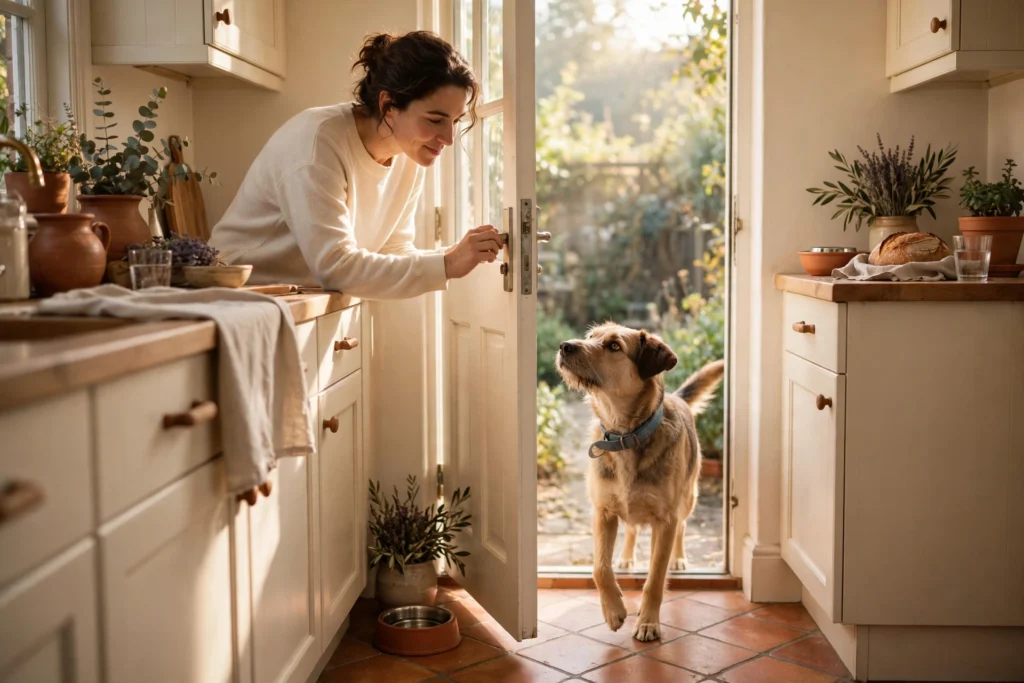
The foster swore he was housetrained. “Never had a single accident in six weeks,” she said, handing you the leash. Day three: a puddle by the back door. Day four: another one in the hallway, while you were standing right there.
If you’re thinking “is he doing this on purpose?” — stop. Dogs don’t do revenge or spite. He’s telling you, in the only language he has, that something isn’t working yet.
Here’s the truth the foster couldn’t tell you: “housetrained” in her home and “housetrained” in your home are two different things. He didn’t forget his training. The rules changed, the smells changed, the doors changed, and stress is overriding everything he learned. The good news? This is fixable — usually within a few weeks.
Related reading: sleeping in bed the first night
Why Accidents Happen in a “Housetrained” Rescue
1. Stress overrides training
A stressed brain doesn’t access learned habits the way a calm one does. Your dog just lost his entire world: routine, people, smells, safe spots. Stress hormones stay elevated for days, increasing bladder urgency and scrambling self-control.
2. The foster’s “housetrained” isn’t your home
Dogs learn in context. He learned: “in that house, with those doors, on that schedule, I go out the back door.” Now everything is different. To his brain, the training is incomplete, not forgotten.
3. New surfaces and smells invite “remarking”
Old urine odor — even from years ago — reads as “dogs pee here” to a dog’s nose. That’s why a rescue can seem to target one specific corner.
4. The schedule changed — and his body is on the old one
His bladder is trained to a rhythm that no longer exists. If nobody opens the door at the old times, he’ll go where he stands.
5. Medical issues — rule these out first
UTIs cause frequent, urgent, sometimes tiny pees. Parasites or food transitions cause bowel accidents. Excessive thirst can signal diabetes or kidney issues. A simple urinalysis rules out the most common culprits in one visit.
Related reading: the 3-3-3 adjustment timeline
The Silent Dog at the Door Isn’t Being Good
Some rescue dogs don’t whine, bark, or paw at the door when they need to go out. They just stand there. Quiet. Still. Then pee on the floor ten feet from the door.
It’s often learned helplessness: somewhere in his past, asking didn’t work. He learned asking changes nothing, so he stopped asking.
The fix: stop waiting for him to ask, and take him out on a schedule anyway. You become the reliable door-opener he never had. Over weeks, many of these dogs start signaling on their own — because for the first time, asking works.
The Retraining Protocol: Assume Nothing, Reward Everything
Week 1–2: Maximum structure
- Out every 2 hours during the day, plus first thing in the morning, after meals, after naps, after play, and last thing at night.
- Same spot every time. A boring patch of grass near the door becomes the bathroom.
- Reward the instant he finishes. Treat within three seconds, with genuine praise.
- Supervise indoors, always. Watch for pre-pee signs — intense floor-sniffing, circling, drifting to a quiet corner.
- When you can’t supervise, confine kindly. A crate or gated area — not punishment; removing the opportunity.
- Keep a simple log for week one. You’ll spot his rhythm within days.
Week 3–4: Loosen carefully
- Stretch the schedule to every 3–4 hours, keeping the after-meal, after-nap, and morning/evening anchors.
- Grant freedom one room at a time.
- Teach a signal — a bell on the door or a consistent cue before each trip.
The non-negotiables (all four weeks)
- Never punish an accident. Yelling teaches him peeing in front of you is dangerous, so he’ll hide to do it.
- Clean every accident like a crime scene with an enzymatic cleaner.
- Don’t restrict water. Manage with schedule and supervision.
Cleaning: The Step Everyone Underestimates
If he can still smell it, he’ll go there again. Regular cleaners and vinegar don’t cut it. You need an enzymatic cleaner: live bacteria that break down urine proteins instead of masking the smell.
How to clean an accident properly:
- Blot up everything you can first.
- Saturate the spot — enzymes must reach everywhere the urine reached.
- Let it sit 10–15 minutes of wet contact time.
- Blot again and let it air dry completely.
- Check with your nose, down at floor level. If you can still smell anything, repeat.
Our pick for the job: Nature’s Miracle Stain & Odor Eliminator #ad — the enzymatic cleaner most rescues and shelters reach for. Keep a bottle by the back door during retraining weeks.
As an Amazon Associate I earn from qualifying purchases.
You’ll also find our rescue-approved cleaning and housetraining essentials on our Creator Hero storefront — affiliate links there support our rescue work at no extra cost to you.
Related reading: First 30 Days Rescue Kit
When to Call the Vet (Not the Trainer)
Call your vet promptly if: sudden onset in a previously reliable dog; frequent tiny pees, straining, or crying while urinating; blood in urine; excessive thirst paired with accidents; diarrhea lasting more than 48 hours; accidents paired with lethargy, appetite loss, or behavior changes.
This Phase Ends — And He’ll Be Better Trained Than Before
Most rescues turn the corner in weeks two to four. The silent dog starts glancing at the door. One day it’s been two weeks since an accident, and you can’t remember when you stopped worrying.
He’s not broken or spiteful. He just needed the rules translated into a language — routine, reward, and a door that opens on time — he could understand.
Grab our free First 30 Days guide for the full day-by-day settling plan.
And because surviving the accident phase deserves a badge of honor: our rescue-proud merch is 10% off first orders with code SPOOKY10 — auto-applied at foundandfearless.com/?code=SPOOKY10.
Found is just the beginning. 🤎