
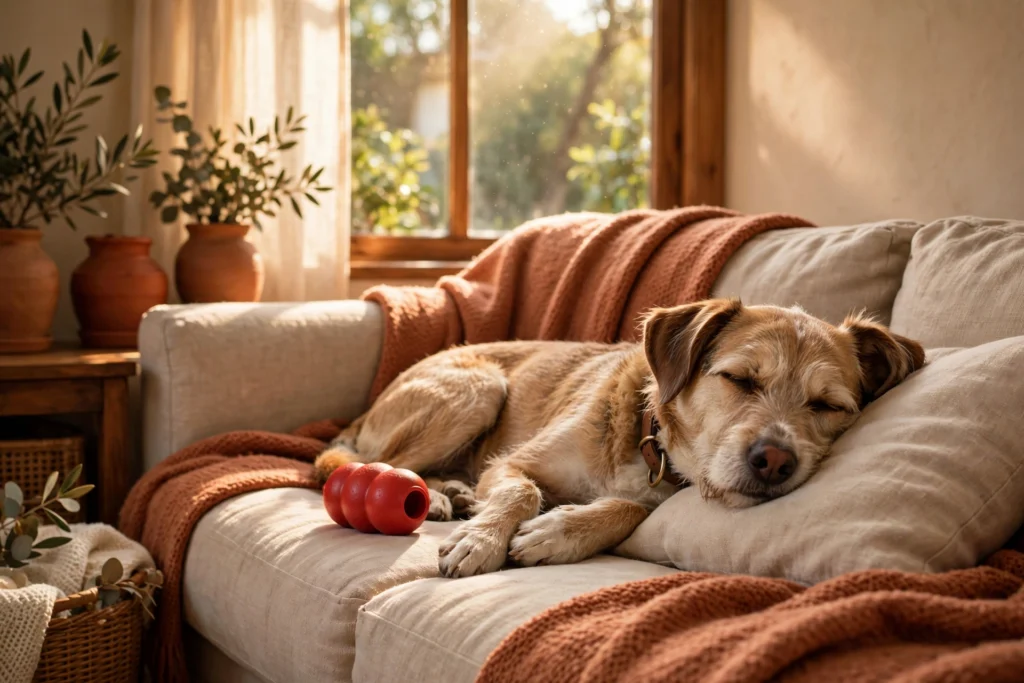
You’ve been home for two weeks with your new rescue dog — couch cuddles, first tail wags, the whole honeymoon phase. Then Monday arrives. The laptop bag comes out, the keys jingle, and your dog looks at you like you’re leaving for a three-year Arctic expedition.
So the question hits hard: can I leave my rescue dog home alone?
The short answer is yes — almost every rescue dog can learn alone time. But the first few weeks home are not the moment to test it with a full eight-hour workday. Your dog isn’t being dramatic. They’re a creature who just landed in a brand-new universe, and you are the only familiar landmark in it.
Why Rescue Dogs Cling (and Why It’s Normal)
A rescue dog who follows you from room to room, including the bathroom, is not broken. They’re adjusting.
Think about what your dog has lived through: the shelter or foster journey, the transport ride, a new house full of new smells and sounds, and one human who keeps showing up with treats and gentle hands. You are the single most predictable, safe thing in their entire world.
Behaviorists call this the 3-3-3 rule: in the first three days, a new dog is overwhelmed and may shut down or refuse food. In the first three weeks, they’re settling in and showing more personality. It takes roughly three months before they truly feel at home. Clinginess peaks in that early window.
Clinginess vs. True Separation Anxiety: How to Tell the Difference
Signs of normal new-dog clinginess (common, usually temporary): follows you room to room, sits on your feet, whines briefly when you step out then settles, gets excited at homecoming but calms down, does fine left for short stretches with something to do, and steadily improves over the first few weeks.
Signs of true separation anxiety (panic, not preference) — per the ASPCA:
- Pacing, panting, shaking, or drooling that starts while you’re still getting ready to leave
- Destructive behavior focused on exit points: scratching, chewing, or digging at doors and windows
- Excessive vocalization most intense right after you leave
- House-training regression occurring only in your absence
- Refusing to eat or take treats while alone
The single most telling difference: what happens in the first 20–40 minutes after you leave. A clingy dog fusses, circles once, and naps. A dog with separation anxiety escalates — and doesn’t come down.
The Alone-Training Protocol: Build in Minutes, Not Hours
Step 1: Make departures and arrivals boring
No long, emotional goodbyes and no over-the-top homecoming celebrations. Leave like you’re grabbing the mail; come back like nothing happened. Boring is the goal.
Step 2: Desensitize your departure cues
Your dog reads your pre-departure routine — shoes, coat, keys, bag, door — as a panic sequence. Break the association: put on your shoes and sit back down, pick up your keys and make a sandwich. Do it so often it becomes meaningless.
Step 3: Practice micro-departures
Step into another room and close the door for 5–10 seconds; come back calmly and repeat. Then: out the front door, count to ten, come back in. Build to 15–20 minutes over a week or two, then push toward 40 minutes — the magic threshold. Ground rules: exercise first, keep sessions short and frequent, end on a win, and don’t jump ahead.
Step 4: Practice while you’re home
Send your dog to their bed with a treat while you cook in the next room. Independence — being calm without physical contact with you — is the actual muscle you’re building.
Enrichment: Give Them Something Better Than Missing You
Set up an alone-time ritual — the same sequence, every time you leave: exercise or play (20–30 minutes), potty break, a high-value long-lasting enrichment item that only appears when you leave, then a calm boring goodbye.
One product we genuinely recommend for alone-time enrichment is the KONG Wobbler — a treat-dispensing toy that wobbles unpredictably and drops kibble as your dog bats it around. Fill it with regular kibble. #ad
As an Amazon Associate I earn from qualifying purchases.
For dogs whose anxiety runs hotter — the pacing, the whining, the can’t-settle energy — some adopters use calming supplements as part of the picture. Zesty Paws Calming Bites are one option rescue families keep on hand for transitions. They’re a supplement, not a training plan. #ad
As an Amazon Associate I earn from qualifying purchases.
You can also browse our curated picks on our Creator Hero storefront: store.creator-hero.com/foundandfearless (affiliate links — we may earn a commission when you shop through them).
Related reading: rescue dog won’t play with toys
The Camera Trick: Check In Without Spoiling the Training
An inexpensive pet camera is the single best investment during alone-training. Most dogs take 10–20 minutes to wind down, which is completely normal. One rule: do not use the camera’s talk feature. Hearing your voice without being able to find you confuses an anxious dog.
When to Get Professional Help
Reach out to your vet or a certified professional if your dog is injuring themselves trying to escape, destruction is escalating after 2–3 weeks of consistent training, they refuse all food while alone, the anxiety isn’t limited to departures, or you’ve plateaued. Find a qualified trainer via the Certification Council for Professional Dog Trainers.
The Honest Timeline
A brand-new rescue dog typically needs two to four weeks of consistent alone-training before a half-day alone feels routine, and one to three months before a full workday is no big deal.
Your rescue dog doesn’t need you home 24/7. They need to learn that when you leave, you always come back — and that the in-between part is safe, boring, and occasionally involves a really excellent frozen peanut butter situation.
Related reading: boarding vs sitter for anxious rescues
Want the full first-month roadmap? Grab our free First 30 Days guide.
Spooky season is here, rescue fam! Treat yourself to something from our merch shop — take 10% off your first order with code SPOOKY10: foundandfearless.com/?code=SPOOKY10
Found is just the beginning. 🤎