
Affiliate disclosure: We may earn a commission when you shop through links in this article. As an Amazon Associate, we earn from qualifying purchases.
Bringing a rescue dog home comes with plenty of decisions. Food should be one of the comforting parts of their day, but choosing a feeding accessory can quickly become confusing. Slow bowls, sliding puzzles, treat balls, and stuffable toys all promise something different. Which one belongs in your home?
Start with the job you want it to do. A slow-feeder bowl puts obstacles between bites during a meal. A puzzle toy asks your dog to discover how to reach food through an activity. There is overlap, but the most useful choice depends on your dog’s comfort, eating habits, and ability to use the design.
Our approach at Found & Fearless is to begin with something manageable. You do not need a basket of products to offer a thoughtful welcome. One suitable item, introduced gently, can be a better starting point than several complicated activities. This guide compares the options and offers a practical way to decide.
What is a slow-feeder dog bowl?
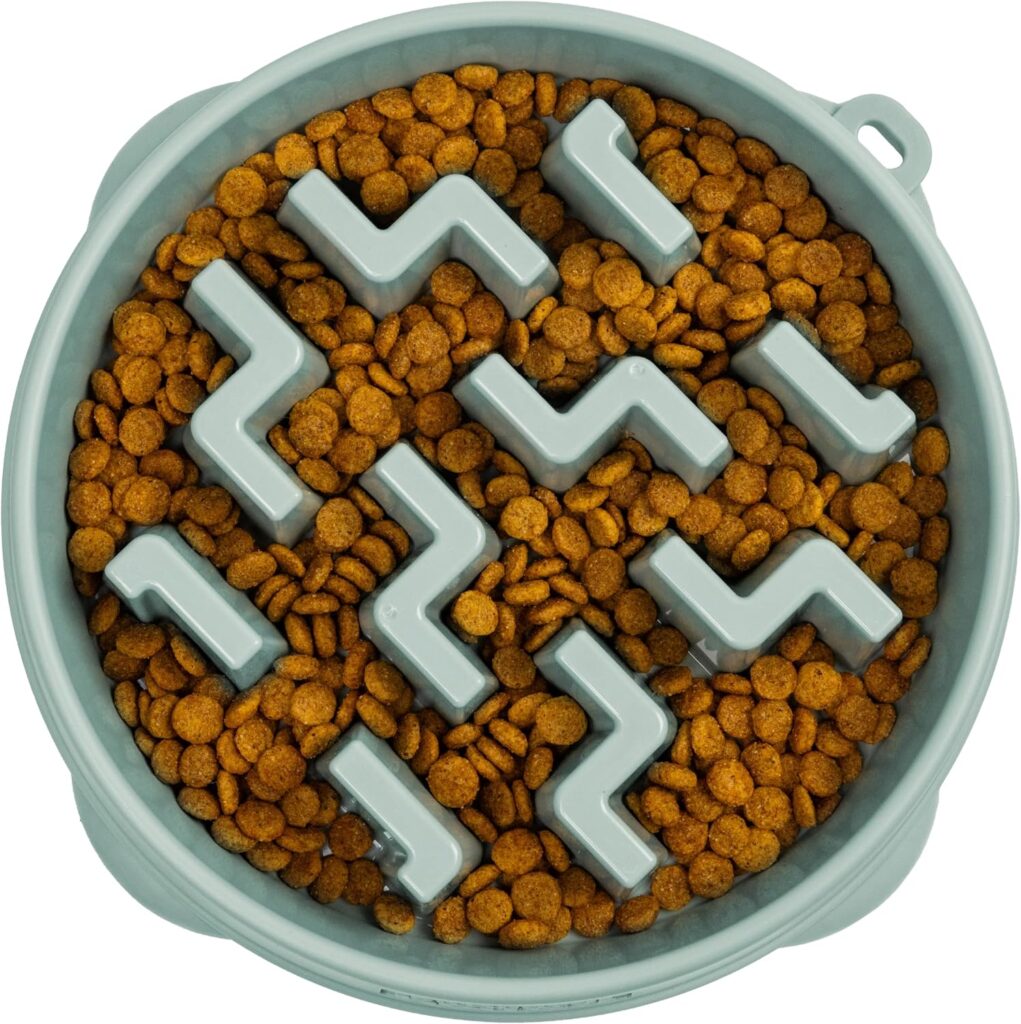
A slow feeder is a bowl with raised ridges, channels, or other obstacles around the food. Your dog works around those features instead of having open access to the whole meal. The American Kennel Club describes this as a way to make it harder to scoop up several pieces of kibble at once.
Think of it as a change to the route between food and mouth. A shallow, open pattern may be easier to navigate than a deep maze. A bowl’s advertised capacity tells you how much it can hold; it does not tell you how much your dog should eat.
The main shopping question is whether your dog can comfortably reach the food. Look beyond the color and check the depth, spacing, base, and overall dimensions. A design that suits one dog’s muzzle can be awkward for another. Choose for your individual dog rather than treating every slow bowl as interchangeable.
What is a food puzzle toy?
Food puzzles include toys that dispense food when rolled or nudged, and boards with compartments that open when parts move. The activity may involve finding, sliding, turning, or lifting. The AKC explains that manipulating the toy to release food is what distinguishes many food puzzles from a conventional bowl.
Difficulty matters. A dog who enjoys finding a few visible pieces may not immediately understand several actions in sequence. Labels such as beginner or intermediate are useful clues, but they do not replace watching your dog’s response. Experience with a different toy also does not guarantee that a new mechanism will be obvious.
A puzzle can be a short shared activity using part of the usual food allowance. It does not have to become the only way dinner is available. For more help introducing an activity, read Your Rescue Dog’s First Puzzle Session.
Slow feeder vs. puzzle toy: a quick comparison
| Consideration | Slow-feeder bowl | Food puzzle toy |
|---|---|---|
| Main task | Reach food around fixed obstacles | Manipulate or explore a mechanism to find food |
| Useful starting goal | Change the pace of an otherwise ordinary meal | Offer a supervised food-based activity |
| What to check | Muzzle access, bowl depth, stability, capacity | Difficulty, moving parts, size, supervision instructions |
| First introduction | Small amount of familiar food in accessible areas | Easiest arrangement, with rewards easy to discover |
| Cleaning | Follow the exact bowl’s care instructions | Check compartments and moving areas, following the manufacturer’s instructions |
These are shopping distinctions, not promises about how any particular dog will respond. A slow bowl still involves exploration, and a food puzzle can also extend mealtime. Decide which feature matters most in your household today.
Which should you try first?
If the goal is a more gradual meal
A simple slow bowl is a reasonable option to consider when you want to change how food is presented without adding a moving mechanism. Begin with the least complicated suitable design. You can observe whether your dog can access the food easily before deciding to use it for an entire meal.
Avoid choosing the hardest maze just because your dog eats enthusiastically. Difficulty is not a measure of quality. If you spend every meal trying to free food from unreachable corners, that design is not serving your routine well.
If the goal is a short enrichment activity
A food puzzle may fit when you want to spend a little time offering a new activity together. Look for a design you can make easy, with food accessible before introducing the full challenge. Plan to supervise rather than setting it down and walking away.
Be realistic about your time. An activity you can prepare, watch, and clean regularly is more useful than an impressive toy that stays in a cupboard. Buying one puzzle does not create an obligation to keep increasing difficulty.
If your dog is still settling in
Keep familiar meals available while learning your dog’s preferences. Our suggestion is to introduce one change at a time, in a quiet setting. That makes it easier to notice what they actually enjoy. A rescue dog does not need to demonstrate confidence with a new accessory on your timetable.
Before purchasing, ask the rescue or previous caregiver about food, feeding routines, and any known difficulties. Those details can help you choose a sensible starting point. If eating or drinking changes, the RSPCA advises contacting a vet; a new feeding product should not become your explanation for every change.
A slow bowl to consider: Outward Hound Sage Notch
The Outward Hound Fun Feeder, Sage Notch, Large is a candidate for medium to large dogs when its dimensions and food access suit them. The manufacturer identifies it as its shallow SLOW level design, with a simple maze, a non-slip base, and capacity for four cups of dry or wet food.
That four-cup figure is capacity, not a serving recommendation. Measure your dog’s established portion separately. This listing is the large Sage Notch version; other colors and patterns may have different designs, so check the selected variant before ordering.
The care instructions specify the dishwasher’s top rack on a low-heat setting. Do not microwave it, use it as a chew toy, or keep using it if damaged. We have not personally tested this bowl; this selection is based on the published specifications and its relatively simple format.
See the Sage Notch large slow bowl in our store. Check current availability, the selected size, and the seller’s details before purchasing.
How it compares with the Hide N’ Slide
Our store also includes the Nina Ottosson Hide N’ Slide, which Outward Hound describes as a Level 2 intermediate puzzle. It has sliding blocks and swiveling flippers, with 14 food compartments. The manufacturer suggests making the activity easier initially by placing food under the flippers before adding the combined actions.
That is a different task from navigating fixed ridges in a bowl. Choose it because a supervised puzzle activity fits your dog, rather than assuming it is automatically better for fast meals. Manufacturer instructions require close supervision, inspection for damage, and putting the empty puzzle away afterward. Clean it with warm water and soap.
Explore the Level 2 Hide N’ Slide, or start with our first-session guide if you already own it. You may find that the right next step is making your existing activity easier, rather than purchasing anything new.
A gentle first introduction
Here is our suggested starting routine. It is a practical example, not a fixed training schedule or a promise that every dog will be ready at the same pace.
- Prepare a quiet space. Put the item on a stable surface where you can observe without crowding your dog. Keep other pets from competing for the same food.
- Use familiar food. Set aside a small amount from the usual portion. Changing the food and feeding accessory together makes the reaction harder to interpret.
- Make access obvious. Place food in easy-to-reach areas of the bowl, or use the puzzle’s simplest supported arrangement. Start with discovery rather than a full challenge.
- Let your dog choose to approach. Give them room to investigate. You do not need to guide their face or paws into place.
- Watch before adding more. Notice whether food is accessible and the item stays stable. If the dog repeatedly bites the accessory, struggles to reach food, or walks away, pause and reassess the setup.
- Keep dinner available. An unfinished activity is useful feedback. It is not a reason to withhold the rest of a meal until your dog solves something.
For example, you might offer a few pieces in the easiest part of the bowl, then serve the remaining measured food in the familiar dish. On a later occasion, if the first introduction went comfortably, you can try a little more. There is no requirement to convert every meal immediately.
What to check before you buy
Start with access: can your dog reach between the features without an awkward fit? Then consider stability: will the item stay reasonably in place on your feeding surface? Check the actual measurements rather than relying on a product photograph.
Next, consider food and cleanup. Does the manufacturer support the food you use? Can you reach the spaces where residue collects? Follow the care instructions for that exact item; dishwasher suitability for one product does not transfer to another.
Finally, consider daily practicality. Where will the accessory be stored? Can you supervise it when required? Will you have time to wash it after use? These ordinary questions help you buy something that fits your life rather than adding another chore.
If your dog has particular dietary or feeding needs, use their veterinary guidance when choosing. A bowl’s marketing cannot determine the right portion or address a feeding problem. Keep fresh drinking water available alongside the routine.
Common questions
Do I need both a slow feeder and a puzzle?
No. Start with the job you want to solve and one appropriate option. You can use an existing suitable item or keep the regular bowl while deciding. Your dog does not need every type of enrichment product to have a caring home.
Does a slow bowl guarantee better health?
No particular outcome is guaranteed. This guide uses slow bowls as a change to food presentation. We are not recommending them as treatment or as a guaranteed way to prevent bloat, weight problems, or other health conditions. Discuss medical concerns with your vet.
Can a puzzle replace a normal meal?
Some designs can hold meal portions, but capacity, food compatibility, and your dog’s ability to retrieve everything matter. Follow the product instructions and your dog’s dietary plan. Keep track of food used in activities so you know what has actually been offered.
Should I choose a harder version once my dog understands it?
Only if that serves your dog and your routine. A comfortable, familiar activity remains useful. You do not need to upgrade just because another design exists, and you can return to an easier arrangement whenever it works better.
Choose one useful next step
For a change to meal presentation, consider a suitable simple slow bowl. For a supervised activity involving moving parts, explore a puzzle at an appropriate level. In either case, begin with familiar food, easy access, and time to observe.
Our Rescue Pet Adoption Checklist can help you plan the wider welcome. Choose what supports the dog in front of you, then let the routine grow together. Found is just the beginning.
Sources and product details
- Outward Hound: Sage Notch large bowl specifications and care
- Outward Hound: Hide N’ Slide instructions
- American Kennel Club: Using meals for enrichment
- RSPCA: Feeding your dog
Product details checked October 6, 2026. Our introduction routine and shopping questions are editorial suggestions based on these general principles, rather than a personal product test.