
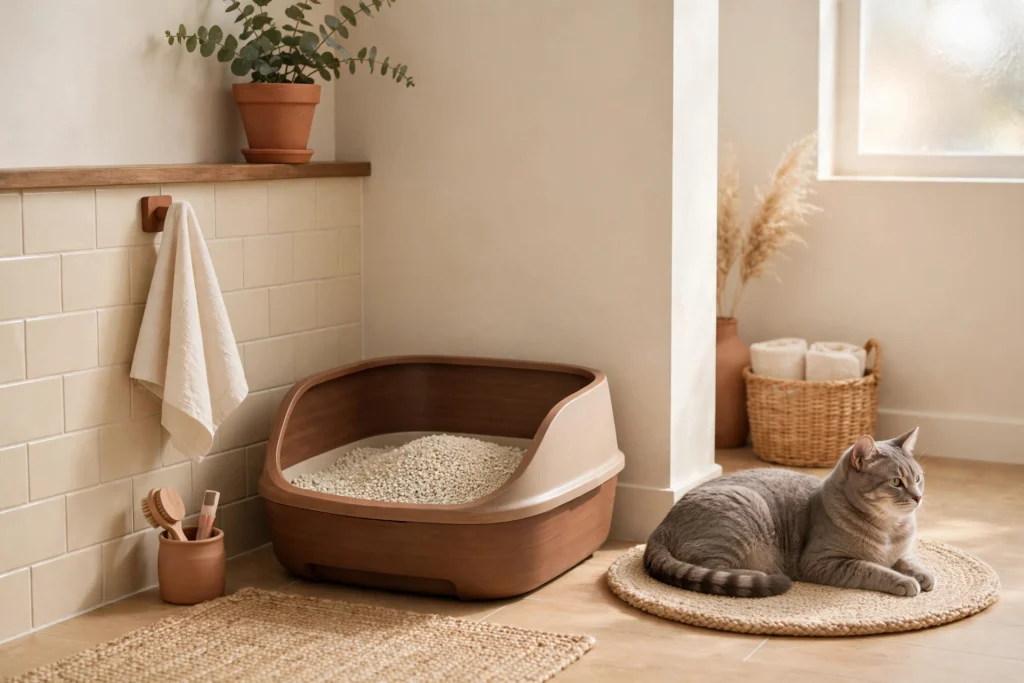
There’s a particular kind of morning heartbreak only new cat parents know. You adopted her three days ago — or three weeks ago — and this morning you found it: a puddle on the rug. And the thoughts start sprinting before your coffee finishes brewing.
Deep breath. You’re not failing, and she’s not broken. Litter box avoidance is one of the most common struggles in a rescue cat’s first month home — and one of the most fixable.
Step Zero: This Is Not a Behavior Problem Until a Vet Says So
Any new litter box avoidance gets a vet visit first. Not after you’ve tried three litters. First. Many “behavior problems” are medical problems in disguise.
Call the vet TODAY if you see: straining to pee with little or no urine (especially male cats — urinary blockage can be life-threatening); crying while urinating, or blood in the urine; running to the box over and over producing tiny amounts; excessive genital licking; sudden lethargy, hiding, or appetite loss alongside box avoidance.
Schedule a regular vet visit soon if: she’s peeing outside the box but otherwise seems fine (rule out UTI); pooping outside the box (GI issues); older and suddenly can’t make it (arthritis, kidney issues).
The Litter Box Audit: Fix the Setup Before You Blame the Cat
1. How many boxes? (The n+1 rule)
One box per cat, plus one extra. In multi-cat homes, one cat may quietly guard a box. A second box in a different room often resolves “mystery” avoidance overnight.
2. Where are they?
Not next to the washer/dryer or anything that roars unexpectedly. Not in a dead-end corner. Not next to food and water. Somewhere quiet but accessible, on every floor she uses.
3. The box itself: size and cover
She should be able to step in, turn around, and dig — roughly 1.5x her body length. Most cats prefer uncovered boxes. Low entry for seniors or kittens.
4. The litter: type, depth, and switching protocol
Most prefer fine-grained, unscented, clumping litter. If the shelter used a particular litter, start with that. To change types, blend old and new gradually over a week.
5. Cleanliness: the deal-breaker nobody wants to hear
Scoop at least once a day — twice during retraining. Wash the box with unscented soap when you dump and replace litter.
The Stress Factor: Why New Rescues Are Special Cases
A cat adopted last Tuesday is living the 3-3-3 rule. Litter box hiccups in weeks one through three are often stress leaking out sideways. Keep her world small and predictable: same feeding times, same quiet room, same humans.
Related reading: building trust with your rescue cat
The Retraining Protocol: A Calm Reset
Step 1: The starter room (temporary, not punishment). One quiet room with food, water, a clean box, a hiding spot.
Step 2: Make the box irresistible. Scoop twice daily. Keep the litter type she likes.
Step 3: Clean old accident spots like a crime scene with an enzymatic cleaner.
Step 4: Reward, never punish. Quiet praise and a treat when she uses the box. Never punish accidents.
Step 5: Expand gradually. After a solid week of reliable box use, open one more room — with a box in it.
Our pick for the cleanup step
Nature’s Miracle Stain & Odor Eliminator — #ad
An enzymatic cleaner is the difference between “cleaned” and “actually clean” with cat urine.
Nature’s Miracle Stain & Odor Eliminator on Amazon #ad
As an Amazon Associate I earn from qualifying purchases.
You can also browse our handpicked rescue-must-have finds on our Creator Hero storefront: store.creator-hero.com/foundandfearless — some links there may earn us a commission at no extra cost to you.
Related reading: First 30 Days Rescue Kit
Keep going — you’ve got this
Litter box trouble feels enormous at 6 a.m. and manageable by week three. Vet first, audit the setup, reduce the stress, retrain with patience.
Related reading: stop your cat scratching the couch
If you’re in the thick of the first 30 days, grab our free First 30 Days guide.
And while she’s settling in, treat yourself a little: our rescue-inspired merch is 10% off your first order with code SPOOKY10 — foundandfearless.com/?code=SPOOKY10
Found is just the beginning. 🤎
Sources: ASPCA — Litter Box Problems.